Thursday, April 12, 2012

Love and Marriage in Paris


This car was parked on the street behind Notre Dame.


It was elaborately decorated for, what else, a wedding party.


However, there was no wedding party in sight.

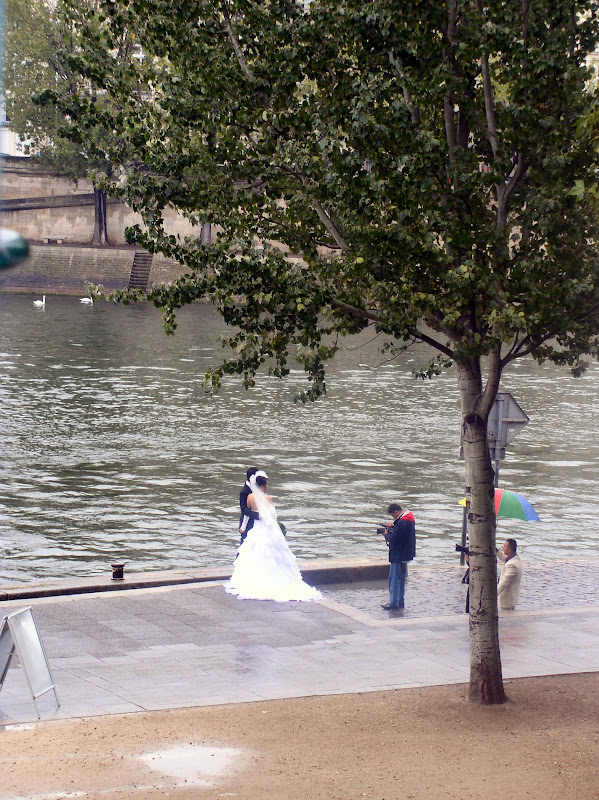
The following Saturday, I was walking across the bridge behind Notre Dame, and down on a quai, right beside the Seine River, there was a stretch limo, a wedding party and a photographer taking photos of a bride and groom. I was thrilled to be there, camera in hand. This must be a very popular place for taking wedding photos, and it’s probably where the missing wedding party of the elaborately decorated car had been when I passed by the other day. The day was overcast, but that didn’t seem to matter. My first photos were from a distance because I doubted there was enough time to go down on the quai to take more pictures. I was wrong. The picture-taking went on and on, and the photographer had the bride and groom pose in a number of ways for quite a while.


The first photos were taken at a distance while I was on the bridge.


The bride and groom and photographers are by the Seine River.


The best man and maid of honor are waiting and watching.

The bride and groom by the Seine


The bride and groom in another pose by the Seine


A boat went by during the photography session, and the people on the boat cheered and waved at the wedding couple. You can see just the tip of the Ile de la Cite in the background.


The bride and groom are standing precariously on the bank of the Seine River. Watching them, I had concerns for their safety


Another boat went by in the other direction, and again, all eyes were on the wedding couple. By this time, I decided there was plenty of time to go down on the quai and take more photos. I didn’t want to be intrusive; I kept my distance, and they didn’t seem to mind.


A close-up of the wedding couple
She is a lovely young woman, and her dress has  tiers upon tiers of ruffles.


I wish them
" Félicitations pour votre mariage”
(Congratulations on your marriage)
 
On the day that we visited the Tuileries, we entered the garden by way of the Cour Napoleon of the Louvre. What great luck! Another wedding couple.


The bride and groom with I. M. Pei’s pyramid in the background


The bride and groom are walking in front of a glass triangle that acts as a skylight to the shopping plaza below the Cour Napoleon.


I send them
 “Tous mes voeux de bonheur”
(All my best wishes)


This time we were visiting the chateau in the town of Fontainebleau, and this bride and groom were standing in the street in front of the Chateau de Fontainebleau. Maybe her mother is giving her a last piece of advice.


The bride and groom crossing the street


I wish them
"Beaucoup de bonheur”
(Lots of happiness)


Once again, in the shadow of Notre Dame, a wedding couple was being photographed.


The wedding couple in front of the Love Locks. This has to be the most meaningful place in all of Paris to take a wedding photo. Here, young lovers vow eternal love, fasten a lock to the wire mesh railing of the bridge and then throw the key into the river.
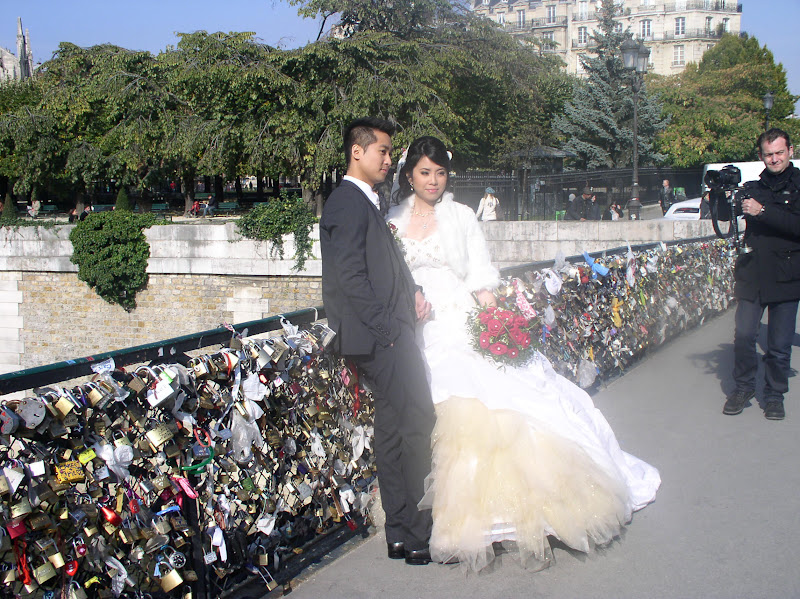

The wedding couple and photographer


The bride and groom with Notre Dame in the background.
They will surely treasure this photo all the days of their lives.
I give them
 “Toutes mes félicitations pour votre journée de mariage”
(My congratulations on your wedding day)


Friday, March 30, 2012

Garden Sculptures

Place de La Reine Astrid

In Paris, a monument in a triangular-shaped area commemorates the beautiful Belgian Queen Astrid who died tragically young at the age of 29 in an automobile accident in 1935.The monument represents France and Belgium joining in friendship. Hauntingly, the Place de la Reine Astrid is near the infamous Place de l’Alma Tunnel, where Diana, Princess of Wales, also perished in a car crash. The monument depicts two women looking at each other and holding hands. There are two children underneath their hands. The inscription below reads:

                       "A LA FRANCE - LA BELGIQUE RECONNAISSANTE - 1914-1918"
                         ("TO FRANCE - FROM A GRATEFUL BELGIUM - 1914-1918")


Marker for La Place de la Reine Astrid


The monument on the Place de la Reine Astrid

The street on the right of the monument is Cours Albert 1er, which runs parallel to the Seine; the street directly behind the monument is Rue Jean Goujon, named after a Renaissance sculptor; and the street to the left of the triangle is Avenue Montaigne, where high fashion houses such as Chanel, Nina Ricci, Louis Vuitton, Christian Dior, Valentino, Emmanuel Ungaro, D&G, Ralph Lauren, and Giorgio Armani are all located.


A closer view of the monument


The two principal figures in the monument,  representing France and Belgium


The monument with the Eiffel Tower in the background


The perfectly rounded clumps of flowers in the flower beds at the foot of the monument


Flowers clinging to a fan-shaped trellis

La Seine
In a small garden at the side of Place de l’Alma, across Cours Albert 1er from the Place de la Reine Astrid, is a reclining statue representing the Seine River. The sculptor, Gerard Choain, was born in Lille in 1906. He was dedicated to traditional sculpture and made many monuments, including La Seine (the Seine River) in the Place de l’Alma. The sculpture was installed in 1962, and Choain won the Grand Prix des Beaux Arts de la ville de Paris. (I first thought that the sculpture was by Maillol, 1861-1944, whose female nudes are in the Tuileries.)


La Seine by Gerard Choain


A closer view of The Seine River


La Seine

The Place de l’Alma is located at the foot of the Pont de l’Alma. La Flamme de la Liberte (The Flame of Liberty), which devoted fans of Princess Diana have turned into her memorial, is across from the Place de la Reine Astrid. Just across the bridge is Des Egouts de Paris (Paris Sewer Museum), and the Musee Branly is a short walk in the other direction. You could spend the whole day sightseeing without leaving the area. I didn’t realize all of these places were in such close proximity until I got there. The metro station is Alma Marceau.

Palais Royal Garden

Cardinal Richelieu built the Palais Royal in the heart of Paris almost 400 years ago. Louis XIV lived there as a young man, and the Dukes of Orléans called it home. Charles X (1824-1830) changed the layout, and it has remained pretty much the same to this day.This former palace now houses offices of France’s Ministry of Culture.


The sign directs visitors to the Palais Royal Garden. This garden may be in the center of Paris, but you don’t just run into it--getting there requires a very roundabout route, and you have to find your way there. That may account for the small number of people in this garden.


An elegant marble statue, Adolphe Thabard’s Le Charmeur de Serpent (The Snake Charmer - 1875), is at one end of the garden. I couldn’t figure out why it was titled “The Snake Charmer” until I found an old rendering of the sculpture before the boy lost parts of his arms.

A flower bed


White roses in a bed near the sculpture


The Snake Charmer

The Snake Charmer  (somewhat intact, with a snake curled around his arm)

 
A double-row of trees runs along both sides of the Garden, and the two fenced lawns stretching between these rows of trees are bordered with flowers. At both ends of each lawn are enclosed sitting areas with benches. Between the two lawns is a circular pond and fountain. It is a lovely area for enjoying the sun and the sound of splashing water.


The expansive lawn


A flower bed on one side of the lawn


A flower bed on the opposite side of the lawn with a view of the row of trees on either side of the garden


The double row of trees on either side of the garden

Paul Lemoyne’s Le Pâtre et la Chèvre (The Shepard and the Goat - 1830) is at the other end of the garden.


The fountain of the Palais Royal Garden

The fountain of the Palais Royal Garden

Square Georges Cain
The square is named after Georges Cain, a painter and writer who was a long-time curator (1897-1914) to the Carnavalet Museum. Built in 1923 but not opened till 1931, it is also an archaeological depository of long-vanished monuments and stunning antique stone relics from the past.


A sign at the entrance to the park
The park is tucked into a side street behind the Musee Carnavalet.


A border of the park with an ivy-covered, "tepee-shaped" trellis


The ivy-covered trellis


A border of the park with the street in the background


A bed of flowers with a stone rosace (ornamental circular sculpture) in the background


A closer view of the stone rosace which was once part of the former Hôtel de ville (City Hall)


A pediment atop a façade and columns from the Palais des Tuileries, surrounding a bas-relief (a decorative carving raised from a flat background).


A bush shaped in a spiral pattern


Another view of the garden beds with a partial view of a stone sculpture


This is a stone sculpture which I can’t identify. It looks like the torso of a gentleman in a flowing gown from antiquity, and it is quite weather-beaten.


The “torso” is resting on a stone platform, as seen from the back


The sculpture in the middle of the rose bed is “Ile de France” by Aristide Maillol (1861-1944). In 1993, the Maillol sculpture replaced “La Flore et son Char” (Flora and her Chariot) by Philippe Magnier (1647-1715). The sculptures aren’t really alike, but I misidentified one for the other. A very knowledgeable viewer set me straight. Thank you, “Anonymous.”


As you enter the park, the Maillol sculpture is directly in the middle.


Ile de France, with the last roses of summer


Ile de France, seen through the roses