FIAC, which stands for Foire Internationale d’Art Contemporain (International Fair of Contemporary Art) is the most important art fair in France. The first FIAC took place in 1974, and the thirty-ninth art fair took place on the third weekend of October, 2012.The venue was the Grand Palais, which becomes a giant art emporium. This year, 182 galleries participated in the event, which is designed to attract contemporary art collectors, museum curators and international dealers. Prior to this year’s FIAC, Madame Jennifer Flay, FIAC Director, pointed out that “many of the 65,000 visitors who are expected to attend the fair this year won’t come with the expectation of buying anything; they will just be there to browse, experience and absorb. There are many different kinds of acquisition of art,” she said. “Monetary exchange at the level of acquisition — that is, purchasing works of art — is only one of the forms of exchange that is possible. For most people there are two kinds that are more accessible — emotional and intellectual acquisition.”
For the seventh consecutive year, FIAC staged exhibitions of art which are “hors les murs,” literally “outside the walls.” One venue was the Tuileries Garden, where sculptures and installations are set up in the garden's fountains, basins, lawns, lanes and groves. I first saw FIAC art installations in 2011 in the Jardin des Plantes. I wasn’t familiar with FIAC and thought it was odd to find such elaborate art installations scattered throughout a garden; some of the art installations were a little odd, too, and had no particular relationship to a garden setting. When I visited the Tuileries shortly afterward, there was FIAC artwork there, also. In 2012, I made a point of visiting the Tuileries during FIAC because I enjoyed seeing the outdoor art. In the photo description, I’ve included only the name of the work and the artist. If you want more information, including an explanation of the artist‘s work, go to the FIAC web site: www.fiac.com (In some cases, neither the French description of the artwork nor the English translation made a lot of sense, but in some cases, neither did the artwork.)


The Glass Pyramid in the Cour Napoleon, the Louvre and the sculpture of Louis XIV

Sculpture of Louis XIV
In 1665, Louis XIV commissioned Bernini to sculpt an equestrian statue of himself. Bernini’s sculpture portrayed the king as a Roman emperor. This typically Baroque sculpture, with its appearance of movement rather than a controlled pose like those of the Renaissance, was sent to Versailles in 1685. Louis disliked it and had it exiled to the far end of the gardens. The American architect I.M. Pei, who was in charge of the grand renovation project of the Louvre, persuaded the officials at Versailles to make a copy of this statue, which he placed in front of his famous Glass Pyramid entrance to the Louvre. This copy, cast in lead, is the only sculpture in the courtyard of the Glass Pyramid. The marble original remains at Versailles.

Close-up of Louis XIV, depicted as a Roman emperor


FIAC Sign (Foire Internationale d’Art Contemporain)

Parce qu’il y a notre pouvoir qui ne l’est pas encore (Because there is our power that is no more, 2012) by Emmanuel Lagarrigue

Parce qu’il y a notre pouvoir qui ne l’est pas encore
The striations in the wood are not a random design--they are Morse Code for a lengthy philosophical quotation engraved in the wood.

Sleep and Echo (2012) by Matthias Bitzer

Sleep and Echo
The sculpture is composed of colored metal rings that overlap and swivel.

Fontaine
(Fountain, 2012) by Elsa Sahal

Fontaine
The sculpture is structured in two parts, or columns, surmounted by a central feminine figure which sends out a continuous stream of water from a height of nearly 10 feet.

Colorful sailboats are at the ready to go into the basin

Deux mêmes choses ne peuvent être pareilles
(No two things can be the same, 2012) by gerlach en coup

Deux memes choses ne peuvent être pareilles
The sculpture involves two rubbish bins, with one of the bins discarded into another.
I had to check to be sure this was really an art installation. It was.

The Origin of the World (2012)
by Marc Quinn

Origin of the World
A realistic shell cast in bronze and nearly 10 feet tall. It is meant to symbolize a woman’s sexuality. 
Modified Social Benches (2012)
by Jeppe Hein

Modified Social Bench

Modified Social Bench

Modified Social Bench

Blue Candle (2010)
by Mark Handforth

Blue Candle
The artist re-envisions an everyday object and creates a sculpture from it.

Sans titre (Untitled, 2012)
by Vincent Mauger


The sculpture is made of stainless steel plates and stainless aluminum tubes. It is the third sculpture by this artist that I’ve seen--last year his work was in the Jardin des Plantes and the Tuileries, and this year again in the Tuileries. Once I knew who sculpted it, I recognized the artist’s precise, symmetrical, totally abstract style.

BBZ (2012)
by Aaron Curry

BBZ
The painted aluminum sculpture is built according to a wooden model carved out by the artist with a jigsaw. The model is then scanned, blown up and reproduced on a larger scale.

Bateau (2011) by Dominique Ghesquiere


In “boat,” the artist questions the precise status of reality: is it really all that exists and is there nothing else? Perhaps this is the bow of a boat, a flat barge that conceals the depths and that floats on the surface ? Or is it a boat at the end of its life, almost fully submerged? Everything happens on the surface.

Chromosaturation (1965)
by Carlos Cruz-Diez

Chromosaturation
An artificial environment consisting of three chambers—one red, one green, one blue— that immerse the visitor in an absolute monochromatic situation. 
Colonne Pascale (2010)
by Pascale Marthine Tayou

Colonne Pascale is composed of 18 enamel pots piled on top of each other. Reaching a height of nearly 20 feet, the result is a totem of everyday objects, which transcends the prosaic nature of its materials.


 The medieval military architecture of fortified castles is the inspiration for this sculpture. Meurtières allow archers to see and shoot arrows at the enemy without being seen. This work echoes the ancient fortifications of the Louvre palace and is placed in the famous Historical Axis.

The continuation of the Historical Axis may be seen through the “arrowslit” in the sculpture. (I tried to get a photo of the axis through the arrowslit, but there were too many people around to get a clear shot.) The imaginary line of the Historical Axis starts in the Cour Napoléon and passes through the Arc de Triomphe du Carrousel and the gardens of the Tuileries. Just beyond, the axis crosses the Place de la Concorde and its Egyptian obelisk before it runs down the Champs-Elysées and reaches the Arc de Triomphe. In modern times, the axis was extended past the city boundary to the Grande Arche de La Defense, a business district with high-rise office buildings. The Grande Arche is a twentieth century version of the Arc de Triomphe, but dedicated to humanitarian ideals rather than military victories.

 For this piece, one of Romania’s typical small wooden houses was dismantled and rebuilt, and a typical rope motif, symbolizing the life-line--or enslavement--was carved into the wooden facade. With the roof removed, the house is no longer functional: the result is a construction midway between cultural heritage and contemporary sculpture.


Meurtrière
(Arrowslit, 2012) by Nicolas Milhe

Arrowslit, from the opposite side of the mirror


Threshold Resign (2012)
by Mircea Cantor


Threshhold Resign

Untitled (2012)
by Philippe Ramette
This sculpture consists of a pole with road signs attached to it. However, the signs only suggest potential directions, since nothing is written on them – there is no indication of the distance to be covered in order to reach one’s destination. Placed in the Tuileries Garden, the work seems to be inviting visitors to continue their stroll.
This sculpture consists of a pole with road signs attached to it. However, the signs only suggest potential directions, since nothing is written on them – there is no indication of the distance to be covered in order to reach one’s destination. Placed in the Tuileries Garden, the work seems to be inviting visitors to continue their stroll.

The Exchange Library (2011)
by Tadashi Kawamata
My first thought was, “What is a bookmobile doing in the Tuileries?” I had to check the list of art installations just to be sure it really was one. It was, and the books on the chair were real--people picked them up, looked them over and put them back on the chair. I’m not sure they realized that it wasn’t really a lending library.

Bookmobile book exchange information

The Exchange Library

Debris clôturé (Fenced in Debris, 2012)
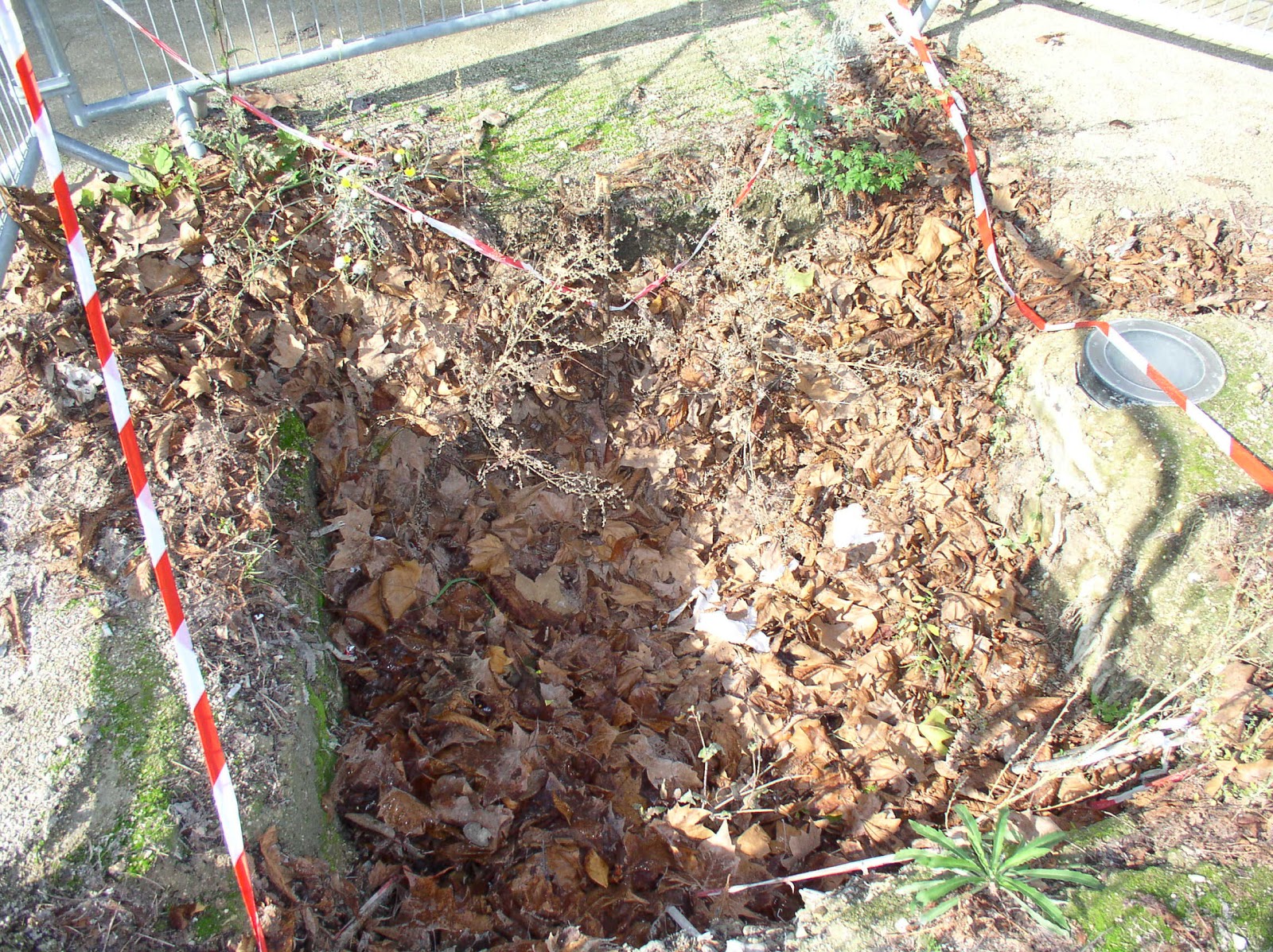
I didn’t know if this was an art installation or not, but I took a couple of pics just in case. What do you think?
Debris
I had to check to be sure this was an art installation. It wasn‘t --it’s only debris, nothing else. 
Blatantly Bronze Landscape (2011)
by Tom Burr


Blatantly Bronze Landscape is part of an ongoing series of mirrored folding screens. It maintains the aspect of a personal dressing room, but reflects both the viewer and the environment. The work blurs the boundary that exists between the personal space of dressing and undressing and the outside world.

Maison bulle à six coques
(The Bubble House, 1968) by Jean Maneval
The Bubble House was constructed of six interlocking, reinforced polyester shells that could be easily transported to and set up at the chosen home site. It is 36m² or a little less than 400 square feet. Maneval's houses came in white, green, and brown—colors that would blend easily into the landscape. This design was used to equip an experimental holiday village in Gripp, in the Pyrenees Mountains. The production of these bubbles stopped around 1970 and remained limited to approximately thirty models.


On Patrol
Holding their formidable-looking weapons, French infantry soldiers walked three abreast along the main pathway of the garden. It was a sobering sight, as if they were doing a sweep of the garden.

Look over the right shoulder of this soldier. You can see two points on the Historical Axis--the obelisk on the Place de la Concorde and the Arc de Triomphe on the Champs Elysees. They look close together, but there is actually more than a mile between the obelisk and the arch.

Fire Walker (2010) by William Kentridge
The sculpture is based on a drawing of a street vendor, known locally as a “fire walker” because of the brazier of hot coals they carry in order to sell roasted corn or meat to passers-by. The sculpture consists of steel plates composed in a 3-dimensional collage. When viewed from the front, there is a coherent image, but becomes disjointed and unrecognizable as the viewer moves around it.

Fire Walker, viewed from the side


Sinfonietta of Light (2012) by Susumu Shingu
A ‘sinfonietta’ can be a small symphony orchestra, especially one consisting of stringed instruments only.
A ‘sinfonietta’ can be a small symphony orchestra, especially one consisting of stringed instruments only.
This installation consists of ten pairs of wings mounted on a vertical axis and attached to floating cones placed on the surface of the water. The white wings dance with the wind, as if they were delicately fluttering birds. Absolutely charming and mesmerizing as you watch the “birds” bob up and down in the breeze.

Close-up of a ‘bird’

'Birds' with a view of the Orangerie Museum

'Birds' in the basin with the Eiffel Tower in the background


